
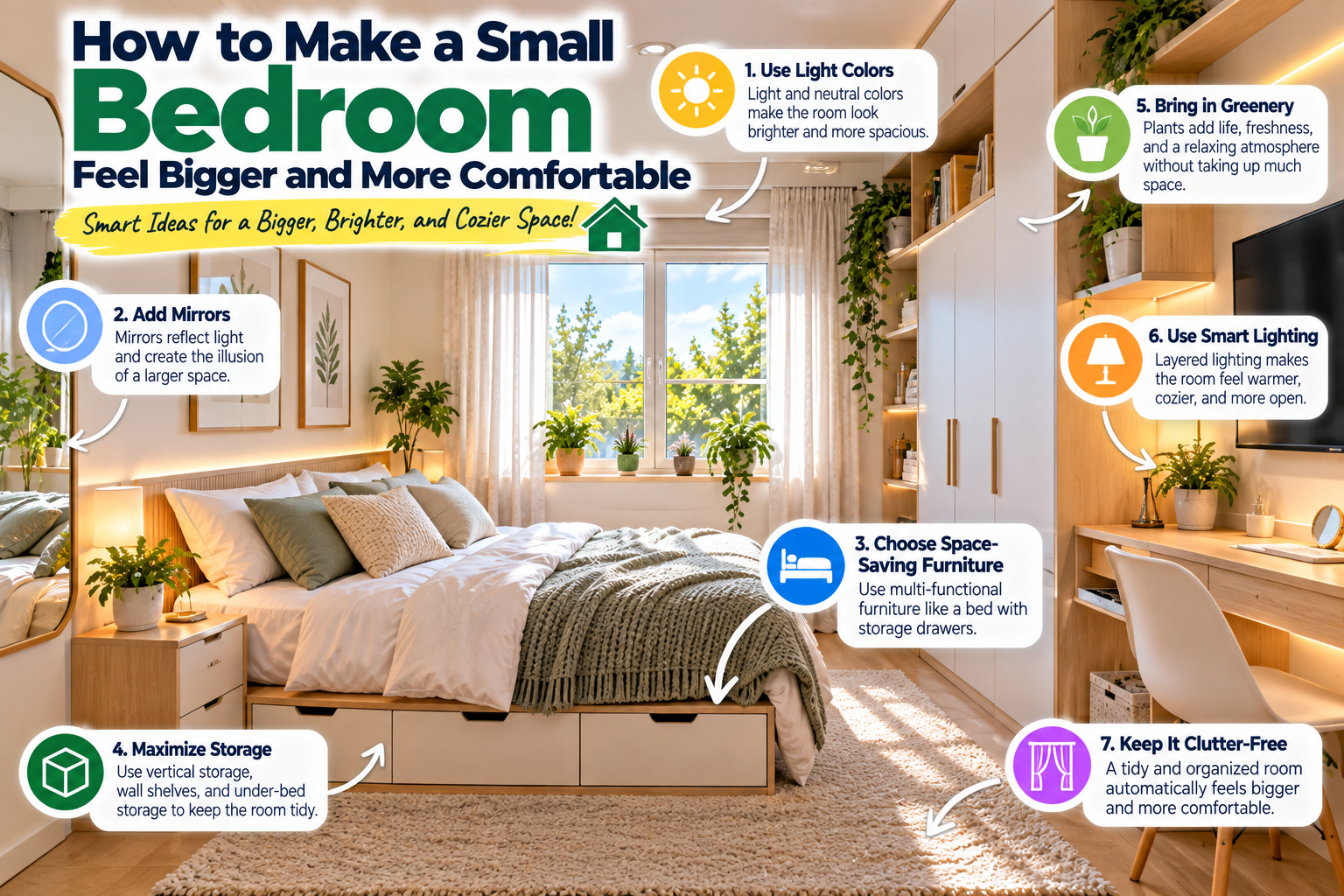
A small bedroom does not have to feel crowded or uncomfortable. With a few simple changes, even a limited space can feel more open, organized, and relaxing.
The best part? You don’t necessarily need expensive furniture or a major renovation.
Take a look around your bedroom right now.
What makes it feel small?
Too much furniture? Clothes everywhere? A dark corner? Not enough storage?
Once you identify the problem, improving the room becomes much easier.
Here are some simple ideas to try.
1. Start by Removing Clutter
Clutter can make a small bedroom feel even smaller.
Start with visible areas such as your floor, bedside table, dresser, and desk.
Ask yourself:
“Do I actually need this item in my bedroom?”
Keep what you regularly use and find another appropriate place for unnecessary items.
You don’t need to organize the entire room at once. Start with one surface.
2. Keep the Floor as Clear as Possible
More visible floor space can help a bedroom feel more open.
Avoid leaving shoes, bags, boxes, and clothes around the room.
Use your closet, shelves, drawers, or suitable storage containers instead.
Quick challenge: Can you remove five things from your bedroom floor right now?
3. Choose Furniture That Fits the Room
Large furniture can overwhelm a small bedroom.
Before buying a new bed, dresser, desk, or chair, measure the available space.
Ask yourself whether each piece of furniture has a useful purpose.
If a chair is only being used as a place to collect clothes, for example, you may not really need it.
Sometimes removing one unnecessary piece of furniture can completely change how a room feels.
4. Use the Space Under Your Bed
The area under the bed can provide valuable storage.
Depending on your bed design, you might use it for seasonal clothing, extra bedding, shoes, or other items you do not need every day.
Use suitable containers to keep everything organized and protected from dust.
But don’t turn the area into a place where random clutter disappears forever.
Know what you are storing there.
5. Take Advantage of Vertical Space
When you cannot expand outward, look upward.
Wall-mounted shelves, hooks, or tall storage units can make use of vertical space without taking up as much floor area.
They can be useful for books, decorations, or lightweight everyday items.
Just avoid covering every wall.
Too much visible storage can make a small room feel busy instead of spacious.
6. Let Natural Light In
Natural light can make a bedroom feel brighter and more open.
During the day, open curtains or blinds when practical and let sunlight into the room.
Avoid unnecessarily blocking windows with large furniture.
If privacy is important, consider window coverings that provide the level of privacy and light control you need.
7. Use Mirrors Strategically
A mirror can reflect light and create a greater sense of depth.
You don’t need to fill the room with mirrors.
One appropriately placed mirror may be enough.
Try positioning it where it can reflect natural light or an open part of the room.
Simple test: Stand in different locations before deciding where the mirror should go. Which position makes the room appear most open?
8. Keep Colors Simple
A simple color palette can help create a calm, less visually crowded bedroom.
Light or neutral shades are popular choices for smaller spaces, but that does not mean your room has to be completely white.
You can add personality through pillows, bedding, artwork, plants, or small decorative items.
The goal is balance.
9. Don’t Overdecorate
Decorations make a bedroom personal, but too many objects can make a small space feel crowded.
Instead of displaying everything you own, choose a few things you genuinely enjoy.
One favorite photograph may have more impact than ten random decorations.
One piece of artwork may work better than an entire wall of unrelated objects.
Give your favorite items room to stand out.
10. Create Simple Zones
Even a small bedroom can have different functional areas.
You might have:
Sleep Zone: Your bed and bedside essentials.
Storage Zone: Closet, dresser, and clothing storage.
Work Zone: A small desk if you work or study in the room.
Keeping these functions organized can make the room easier to use.
11. Keep Your Bed Simple
The bed is usually the largest object in a bedroom.
Too many pillows, blankets, or decorative items can make it visually heavy.
You don’t have to remove everything.
Simply choose bedding that feels comfortable without overwhelming the room.
A neatly made bed can also make the entire bedroom look more organized within minutes.
12. Improve Your Lighting
One ceiling light may not always create the most comfortable atmosphere.
Depending on your needs, consider adding appropriate bedside or task lighting.
Good lighting can make different parts of the room more functional while creating a comfortable atmosphere in the evening.
If floor space is limited, wall-mounted lighting may be an option where appropriate.
13. Make Storage Easy to Use
Complicated storage systems often fail because they require too much effort.
Keep frequently used items easy to reach.
Store less frequently used belongings in less accessible areas.
For example:
Daily clothes: Easy-to-reach drawers or closet space.
Occasional items: Higher shelves.
Seasonal belongings: Appropriate containers under the bed or elsewhere.
The easier your system is, the more likely you are to keep using it.
Try the 15-Minute Bedroom Challenge
Want your room to feel better today?
Set a timer for 15 minutes.
Spend the first five minutes removing things from the floor.
Spend the next five minutes clearing your bedside table or dresser.
Spend the final five minutes putting clothes and other misplaced items where they belong.
Then stand at the bedroom door and look around again.
Does the room already feel different?
Sometimes you don’t need a renovation. You simply need less visual clutter.
Final Thoughts
Making a small bedroom feel bigger is not necessarily about creating more physical space.
It is about using your existing space more effectively.
Remove unnecessary clutter, keep the floor visible, choose appropriately sized furniture, use vertical storage, improve lighting, and avoid filling every available surface.
Most importantly, remember that your bedroom should be comfortable.
It does not need to look like a showroom or a perfect social media photo.
It needs to work for you.