
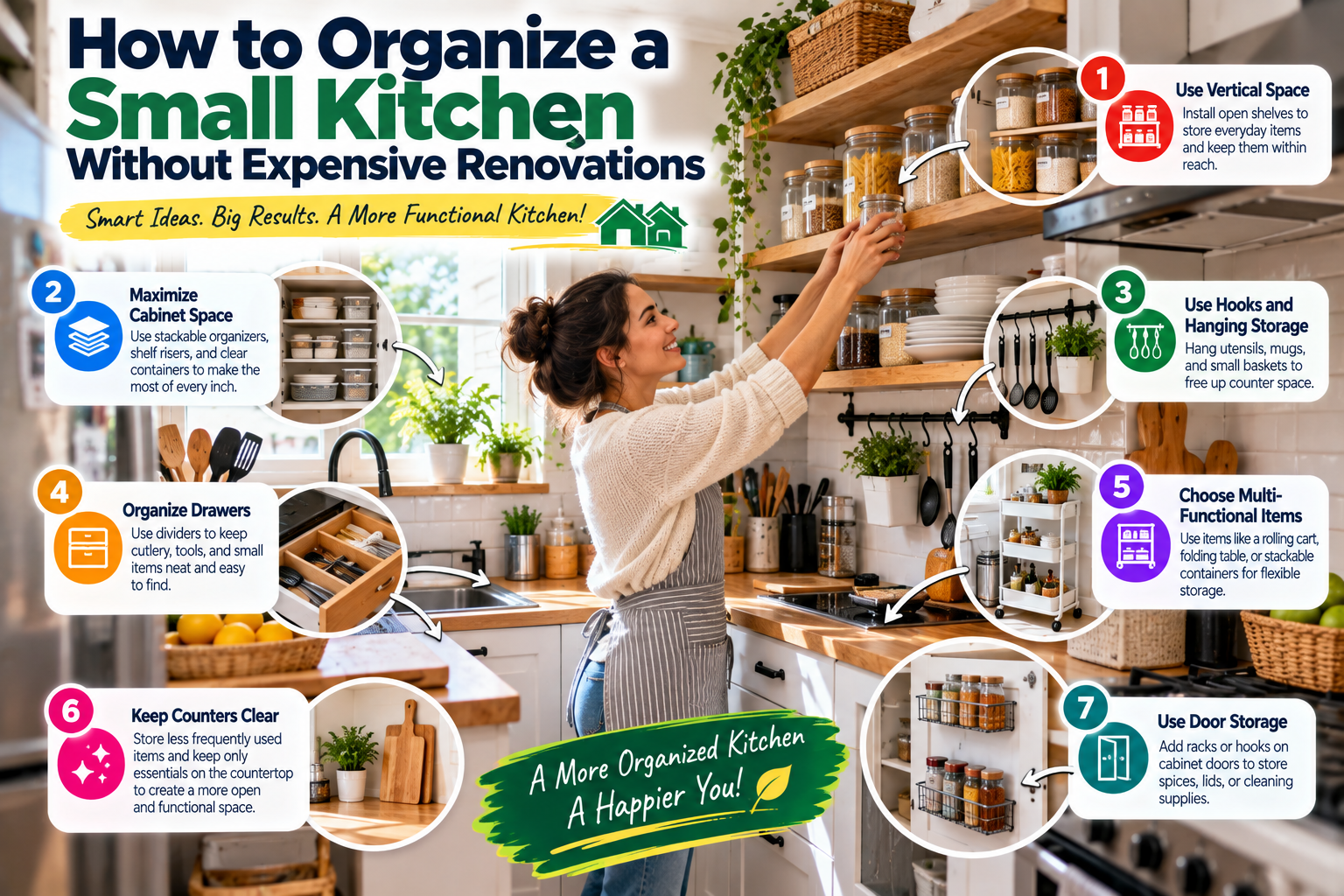
A small kitchen can quickly feel crowded. A few appliances on the counter, too many food containers in the cabinets, and one overflowing drawer may be enough to make cooking feel stressful.
But here’s the good news: you don’t necessarily need an expensive renovation to make a small kitchen more organized.
Before thinking about new cabinets, countertops, or a bigger kitchen, try making better use of the space you already have.
Ready? Let’s start with a simple challenge.
Stand in your kitchen and ask yourself:
“What are the three things taking up the most unnecessary space?”
Keep your answers in mind as you work through these ideas.
1. Start by Removing What You Don’t Use
The easiest way to create more kitchen space is not to buy another organizer. It is to own fewer unnecessary items.
Open one cabinet.
How many things inside have you actually used during the past year?
You may discover duplicate utensils, damaged containers, unused mugs, expired food, or appliances you rarely touch.
Create three groups:
KEEP — Items you regularly use.
DONATE OR GIVE AWAY — Useful items you no longer need.
DISCARD OR RECYCLE — Damaged or unusable items, following your local disposal options.
Do one cabinet at a time so the project does not become overwhelming.
2. Keep Your Countertops as Clear as Possible
Counter space is extremely valuable in a small kitchen.
Look at your countertop right now.
Do you really need every appliance sitting there all day?
A coffee maker you use every morning probably deserves its place. A large appliance you use once every two months may not.
Store less frequently used equipment in a cabinet or another appropriate storage area.
Try to leave at least one clear section of countertop for food preparation.
The kitchen may immediately feel larger.
3. Use Vertical Space
When floor and counter space are limited, look upward.
Walls, cabinet interiors, and vertical storage areas may provide additional opportunities.
Depending on your kitchen layout, you might use:
- wall-mounted shelves;
- hooks for suitable utensils;
- stackable cabinet organizers;
- magnetic storage designed for appropriate items; or
- vertical dividers for baking sheets and cutting boards.
The goal is not to cover every wall with storage.
Use vertical space strategically so frequently used items remain accessible without making the kitchen visually crowded.
4. Organize Cabinets by Frequency of Use
Not everything deserves the easiest-to-reach shelf.
Think about your daily routine.
Plates, glasses, cooking tools, and ingredients you use frequently should generally be easy to access.
Items used only for special occasions can go higher or farther back.
Try this simple rule:
Daily use = easiest location
Weekly use = nearby storage
Rare use = higher or less convenient storage
This small change can make everyday cooking much easier.
5. Create Simple Kitchen Zones
Professional kitchens are organized around tasks, and you can borrow the same idea at home.
Create small zones based on what you do.
For example:
Coffee Zone: Coffee, filters, cups, and related supplies.
Cooking Zone: Pots, pans, cooking utensils, and frequently used seasonings.
Food Preparation Zone: Cutting boards, knives, mixing bowls, and measuring tools.
Cleaning Zone: Dishwashing and cleaning supplies stored safely.
When related items stay together, you spend less time walking around looking for things.
6. Make Better Use of Drawers
The famous kitchen “junk drawer” can become a black hole for random objects.
Open yours.
Can you find what you need within five seconds?
If not, it may be time to reorganize.
Simple drawer dividers can separate utensils and small tools. You do not necessarily need expensive organizers.
The important part is giving each category a defined location.
And remember: a drawer organizer cannot solve the problem if the drawer contains twice as many objects as it should.
Declutter first. Organize second.
7. Use the Inside of Cabinet Doors Carefully
The inside surface of certain cabinet doors may offer additional storage.
Small organizers or hooks designed for cabinets can sometimes hold lightweight items.
However, make sure anything you install does not prevent the door from closing or interfere with shelves inside.
Avoid overloading doors with heavy objects.
A little additional storage is useful. A damaged cabinet door is not.
8. Organize Food by Category
A crowded pantry or food cabinet becomes much easier to manage when similar items stay together.
Try categories such as:
- breakfast foods;
- pasta and rice;
- canned foods;
- snacks;
- baking supplies;
- spices; and
- sauces.
You do not need dozens of matching containers to make this system work.
Start by grouping what you already have.
Place frequently used items where they are easy to see.
This can also help prevent buying something you already own but could not find.
9. Use Clear Containers Only When They Actually Help
Beautiful kitchens on social media often feature rows of identical containers.
They look attractive, but you do not need to transfer every ingredient into a new container.
Use containers when they solve a real problem.
For example, airtight containers may be useful for certain dry foods, while simple bins can help group small packets or snacks.
Avoid buying an expensive container collection before measuring your shelves.
Otherwise, your new organizers may become additional clutter.
10. Don’t Forget the Refrigerator
A small kitchen often comes with a small refrigerator, so organization matters here too.
Check what is inside.
Are there expired products?
Three nearly empty bottles of the same sauce?
Leftovers nobody remembers?
Clean the refrigerator periodically and group similar foods together.
Keep frequently used items visible so they are less likely to be forgotten.
A simple rule can help:
Older food toward the front, newer food behind it.
This encourages you to use existing food before opening something new.
11. Control Your Collection of Food Containers
Food storage containers have a mysterious ability to multiply.
The lids disappear. The containers remain.
Take them all out and match every container with its lid.
If you have containers without lids or lids without containers, decide whether keeping them makes sense.
Then stack compatible containers together.
This single task can sometimes free an entire cabinet shelf.
12. Consider Movable Storage
If your kitchen has a small unused corner, a narrow rolling cart may provide additional storage without permanent renovation.
It could hold pantry items, small appliances, or cooking supplies.
The advantage is flexibility.
You can move it when necessary.
But measure your space before buying anything. A cart that blocks a walkway will make a small kitchen feel even smaller.
13. Avoid Buying Too Much at Once
Buying in bulk can sometimes save money, but storage space also has value.
If your cabinets are already full, buying enormous quantities may create unnecessary clutter.
Before buying a large package, ask:
“Where exactly will I store this?”
If you cannot answer immediately, reconsider whether the larger quantity is practical for your home.
14. Give Every Item a Home
This is perhaps the most important organization principle.
Every object should have a normal storage location.
When you finish using the blender, where does it go?
Where do scissors belong?
Where should grocery bags be stored?
If an item has no designated place, it will probably end up on the countertop.
You don’t need a complicated system.
You need a system you can remember.
15. Reset the Kitchen for Five Minutes Every Evening
Organization is not a one-time project.
Even the most carefully organized kitchen can become messy after cooking.
Try a five-minute evening reset.
Put away clean dishes.
Return ingredients to their places.
Clear the countertop.
Throw away appropriate trash.
Put misplaced items back where they belong.
Five minutes today can prevent a 45-minute cleanup later.
Try the 30-Minute Small Kitchen Challenge
Want to start right now?
Set a timer for 30 minutes.
First 10 minutes: Remove unused items from one cabinet.
Next 10 minutes: Clear unnecessary objects from the countertop.
Final 10 minutes: Organize one drawer or food shelf.
Then stop.
You don’t need to organize your entire kitchen in one day.
Repeat the challenge tomorrow if necessary.
What You Don’t Need to Buy
Before finishing, remember that organizing a kitchen does not require purchasing dozens of products.
You may not need new cabinets.
You may not need expensive containers.
You may not need custom shelving.
Sometimes the biggest improvement comes from simply removing unnecessary items and arranging the remaining ones according to how often you use them.
Use what you already have first. Buy an organizer only when you have identified a specific storage problem it can solve.