
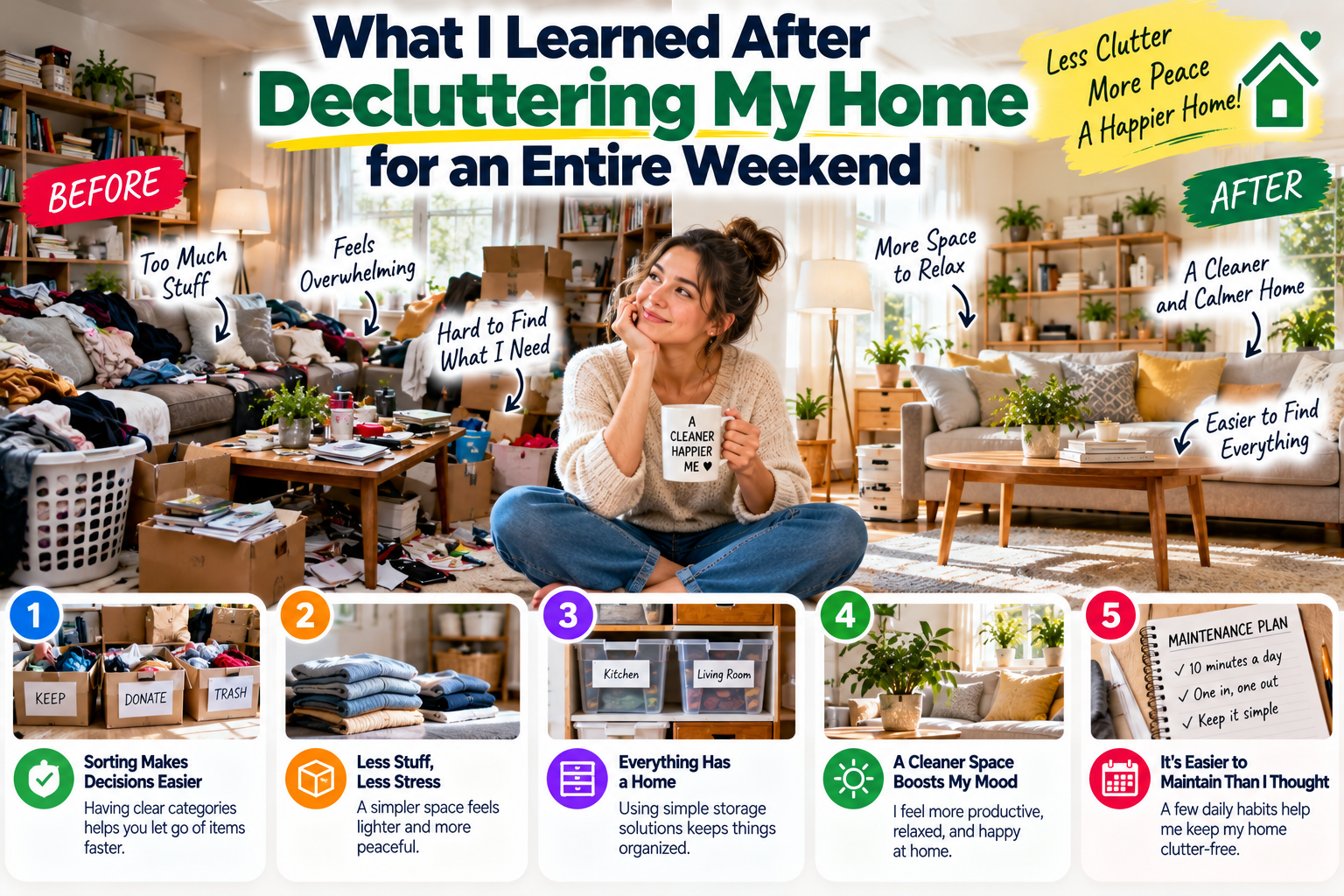
I used to think my home was reasonably organized.
Sure, there were a few boxes in the garage, some clothes I rarely wore, and a kitchen cabinet that was almost impossible to close. But nothing seemed serious enough to worry about.
Then one Friday evening, I opened a storage closet and a pile of things nearly fell on me.
That was my moment.
I decided to spend an entire weekend decluttering my home.
I expected to finish with cleaner rooms and more storage space. What I did not expect was how much the experience would teach me about my shopping habits, the things I keep, and how easily clutter can become part of everyday life.
Here is what I learned.
Lesson 1: I Owned More Than I Realized
My first project was the bedroom closet.
I removed everything and placed it on the bed.
That was a mistake—or maybe it was exactly what I needed.
Suddenly, I could see how much I owned.
There were shirts I had forgotten about, clothes that no longer fit, empty boxes, old bags, and several items I had apparently been saving for “someday.”
Have you ever done this?
Open one of your closets and look at the back.
How many things have you not touched in the past year?
When our belongings stay hidden inside cabinets and drawers, it is easy to forget they exist.
Taking everything out made the amount of clutter impossible to ignore.
Lesson 2: The Hardest Part Was Making Decisions
Moving things was easy.
Deciding what to do with them was much harder.
I kept asking myself:
“What if I need this someday?”
That question can justify keeping almost anything.
So I changed the question.
Instead, I asked:
“If I needed this tomorrow and didn’t already own it, would I actually buy it again?”
That made decisions easier.
For many items, the answer was no.
Lesson 3: Decluttering Is Not the Same as Throwing Everything Away
At first, I thought decluttering meant filling trash bags.
It doesn’t.
Some things were still perfectly useful.
I created four categories:
KEEP — Things I actually use.
DONATE — Useful items I no longer need.
SELL — Items that might still have enough value to sell.
DISPOSE OR RECYCLE — Things that were damaged, unusable, or appropriate for available recycling options.
This approach made the process feel less wasteful.
Instead of asking, “Should I throw this away?” I could ask, “Where should this item go next?”
That small change made a big difference.
Lesson 4: The Kitchen Was Full of Surprises
Saturday afternoon was dedicated to the kitchen.
I expected it to be easy.
It wasn’t.
I found duplicate utensils, food containers without matching lids, old spices, several mugs I never used, and appliances that had been sitting untouched for years.
Then I reached the food cabinets.
Let’s just say checking expiration dates became an important part of the afternoon.
Here’s a challenge for you:
Open your kitchen drawer with the most utensils.
How many of them do you regularly use?
You may be surprised.
Lesson 5: Small Clutter Creates Big Stress
One thing became obvious as the weekend continued.
No single object was causing the problem.
It was the accumulation of hundreds of small things.
A receipt on the counter.
An empty box in the garage.
A shirt I never wore.
A cable I could not identify.
A broken kitchen tool I kept meaning to replace.
Individually, none of these things mattered much.
Together, they made the house feel crowded.
After removing them, the rooms did not just look cleaner. They felt calmer.
Lesson 6: Organizers Don’t Solve Everything
I used to believe I needed better storage.
More containers.
More shelves.
More organizers.
During my decluttering weekend, I realized something important:
Sometimes you don’t have a storage problem.
You have too much stuff.
Buying another storage box would simply have allowed me to hide more things.
I decided not to buy any new organizers until I finished decluttering.
Interestingly, once I removed what I did not need, many of my storage problems disappeared.
Lesson 7: The “Maybe” Pile Is Dangerous
At one point, I created a pile of things I was not ready to keep or remove.
I called it the “maybe” pile.
Within an hour, it became the largest pile in the room.
That was not helpful.
So I created a new rule.
If I could not explain why I wanted to keep something, it probably did not deserve valuable storage space.
Of course, sentimental objects were different.
I did not force myself to make quick decisions about family photographs, letters, or meaningful gifts.
Decluttering should make life easier, not turn into a competition to own as little as possible.
Lesson 8: Sentimental Items Need Their Own Time
Sunday morning brought me to old photographs and personal belongings.
Progress immediately slowed.
A normal T-shirt can take five seconds to evaluate.
A box of family photographs can take an hour.
I learned that sentimental items should not be mixed into a fast decluttering session.
If you find something meaningful, put it somewhere safe and return to it later.
You do not need to make every emotional decision in one weekend.
Lesson 9: Getting Rid of Clutter Requires a Plan
By Sunday afternoon, I had successfully created several piles.
Great.
But now those piles needed to leave the house.
This is something I had not planned carefully enough.
Donations needed appropriate destinations.
Recyclable materials needed to go to suitable facilities or collection programs.
Some large unwanted items required more planning.
If you are decluttering a large amount of stuff, think about removal before you begin.
Ask yourself:
Where will donations go?
What recycling options are available locally?
Can ordinary trash collection handle what remains?
Do bulky items require special pickup or a junk removal service?
Otherwise, you may simply transform indoor clutter into garage clutter.
Lesson 10: I Became More Careful About Buying New Things
This may have been the biggest lesson.
After spending an entire weekend deciding what to remove, I suddenly became much more interested in what I was bringing into the house.
When shopping, I now try to ask:
“Where will this live in my home?”
and
“Do I actually need it?”
If I cannot answer the first question, buying the item deserves a second thought.
Decluttering showed me that every purchase eventually requires space, organization, cleaning, maintenance, or disposal.
The purchase price is not the only cost of owning something.
My 10-Minute Decluttering Rule
After that weekend, I knew I did not want to repeat such a huge cleanup anytime soon.
So I started using a simple habit.
Set a timer for ten minutes.
Choose one small area.
A drawer.
A shelf.
A countertop.
A section of the closet.
Remove what does not belong there and stop when the timer ends.
Ten minutes does not sound impressive, but doing it regularly keeps clutter from becoming another weekend-long project.
Want to Try It? Start With One Drawer
If your home feels cluttered, don’t start by emptying every room.
Start with one drawer.
Take everything out.
Then ask four questions:
Do I use this?
Do I need this?
Does it belong somewhere else?
Would I buy it again today?
Put back only the things that deserve the space.
Then move to the next small area when you are ready.
What I Would Do Differently Next Time
If I repeated my decluttering weekend, I would make a removal plan first.
I would prepare boxes for donations, identify local recycling options, and decide how bulky items would be handled before starting.
I would also avoid sentimental items until the end.
Most importantly, I would not try to make every room perfect.
The goal is not perfection.
The goal is creating a home that is easier to use.